Conversations
What we're saying, what's being said, what should be said.
BMW Is Setting Records. Harley Is Closing Dealerships. Here's Why.
Brand authority compounds. Drift doesn't. BMW and Harley-Davidson prove it.
I've been in this industry long enough to watch brands come and go. The ones that arrived with momentum and disappeared within five years. The ones that looked like they had everything and somehow ended up with nothing. And the ones that just kept going. Quietly compounding. Getting harder to ignore, not easier, as the years passed. When I was researching the previous essay, I was happy to learn (but not surprised) that BMW had overtaken Harley-Davidson in the US market. The brands that last don't last by accident.
The difference isn't budget or distribution or timing, although timing helps. The difference is that the brands that last know what they are and refuse to stop being it. That sounds simple, but it isn't. The pressure to drift is constant. A bad quarter and someone suggests a promotion. A new trend emerges, and someone asks if the brand should respond to it. A competitor enters with a louder message, and suddenly everyone is questioning whether the brand's own message is too quiet. The market is always offering a different game to play. The brands that last are the ones that kept playing their own.
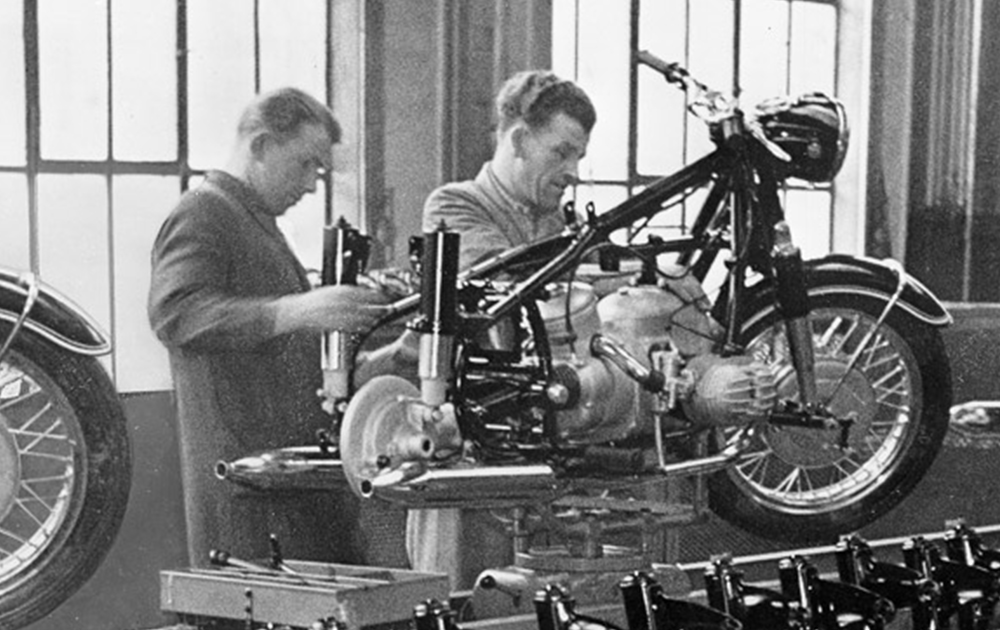
In 1919, the Treaty of Versailles banned Germany from producing aircraft engines, which BMW had been making since 1916. Overnight, the company's entire reason for existing was suddenly illegal. Max Friz, BMW's head designer, had four weeks to figure out what the company would make instead. In those four weeks, he designed the now-iconic horizontally opposed twin-cylinder engine, with cylinders jutting out to each side. Not a brand strategy, but a survival decision made under pressure with no apparent alternative.
That engine became the R32 in 1923, and the BMW boxer engine has been the cornerstone of BMW’s motorcycle lineup since that first production bike over a century ago. The unique flat twin-cylinder configuration provides excellent natural balance and reduced vibration. BMW calls the result 'The Ultimate Riding Machine' — borrowing their own automotive tagline 'The Ultimate Driving Machine' and adapting it for two wheels. It works because both claims rest on the same foundation. The language didn't travel by accident. The engineering philosophy behind it did.
The contrast with Harley-Davidson is extraordinary. BMW Motorrad ended 2024 with 210,408 new bike sales — the highest figure in the company's 102-year history. The bestseller was the big GS boxer line, with over 68,000 customers choosing an R1300GS, R1300GS Adventure, or R1250GS (I rode a R1200GS Adventure for years, so yes, I’m biased and for the curious, GS stands for "Gelände/Straße", German for "off-road/road"). For context, that single model family outsells Ducati's entire global lineup.
Meanwhile, Harley is in freefall, BMW is setting records, and the reason comes down to exactly what this essay is about. BMW never stopped asking what the boxer engine actually meant. It evolved the technology — the R1300GS now features a 1300cc, 145hp engine — the most powerful production BMW boxer engine ever made — while keeping the identity intact. The cylinders still stick out the sides. The bike still looks unmistakably like a BMW. The Core Truth was never traded for trend, and the 103-year-old engine architecture is still the brand's bestselling platform. Not because BMW refused to change — they've added ShiftCam variable valve timing, water cooling, electronic rider aids — but because they kept the thing that made the engine theirs while evolving everything around it. That is the difference between a brand that defends its Core Truth and a brand that mistakes its name for its identity.
In 2026, BMW marks 50 years of its RS model line, a badge that has defined its unique blend of sport and touring performance since 1976, when the R100RS became the world's first large-series motorcycle to feature a frame-mounted, wind-tunnel-developed full fairing, effectively creating the modern sport-touring segment. The brands I've watched build something real over the long term all had that same thing in common. They found the true thing at their center, expressed it clearly, and defended it. Not aggressively. Not loudly. They just didn't give it up when the pressure came. Authority compounds. Drift doesn't.
The question isn't whether your brand has what it takes to last. Most brands have more than they're expressing. The question is whether you're willing to find it, name it, and refuse to let it go come hell or high water.
That's the long game. And it's the only one worth playing.