Conversations
What we're saying, what's being said, what should be said.
They Had the Best Mission Statement in the Industry. Then They Replaced It.
Virgin Atlantic had language no competitor could claim. Then they gave it up.
I once took a flight from London to New Delhi in Upper Class on Virgin Atlantic. I don't remember the year precisely, but I do remember the bar.
Not the bar itself exactly — though a bar at 35,000 feet was its own kind of statement. I remember sitting there, somewhere over Central Asia, in conversation with people I had never met before and never met again. The crew was part of it. Too late to be sitting there, but also too wired not to be. We were just people, briefly suspended above the earth together, genuinely enjoying each other's company. It felt like something the airline had intended, yet 100% unscripted. Like the whole experience had been designed around the belief that flying should feel like this. It had been, and that was the point.
I want to talk about the best mission statement ever written for an airline.
Actually, I want to talk about what happened to it.
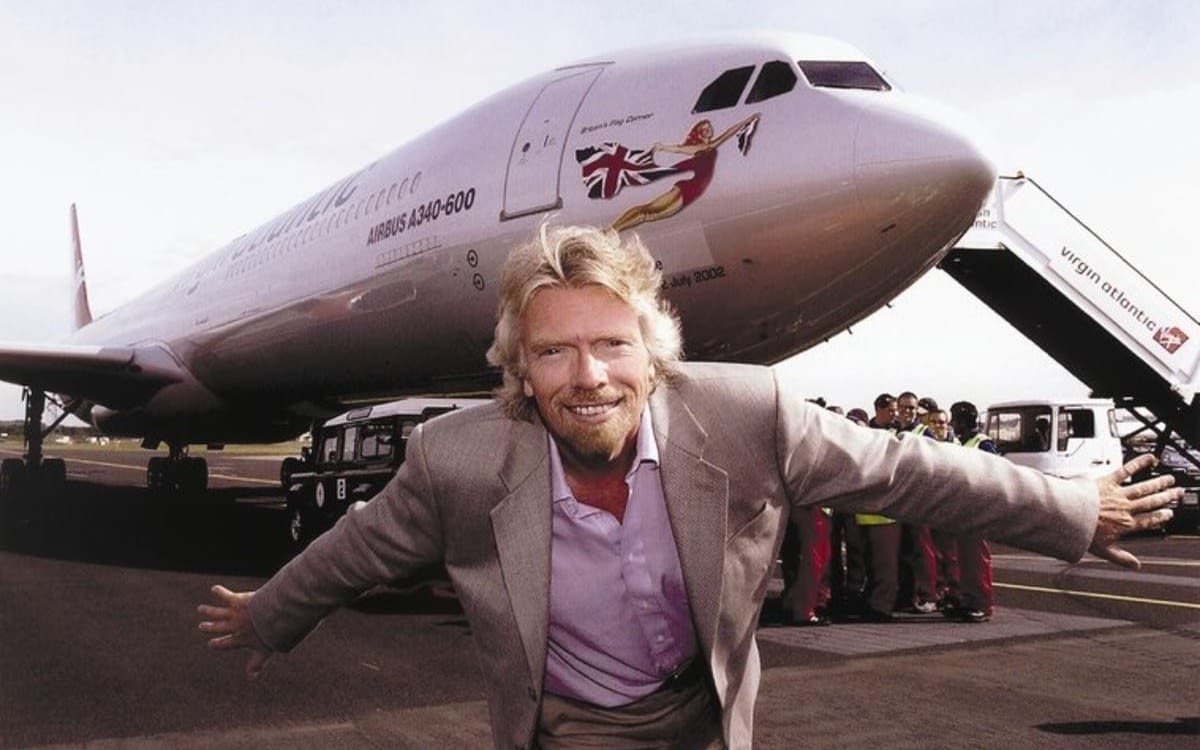
In 1984, Richard Branson launched Virgin Atlantic into one of the most competitive and commoditized markets in the world. Flag carriers. State subsidies. Routes that had been carved up between the same airlines for decades. The conventional wisdom was that you competed on price, loyalty points, and whether you could get someone from London to New York without losing their luggage.
Branson disagreed. Not just about the product, but about what the product meant. He believed flying should feel like something. That the act of getting on a plane and crossing an ocean was an expression of human possibility, not just a transaction between a company and a place for your butt. And somewhere in that belief, the mission statement was born.
"Our mission statement is simple, yet the foundation of everything we do here at Virgin Atlantic Airways. To embrace the human spirit and let it fly."
Read it again. It works on three levels at once. It's literal — they fly people. It's emotional — they believe in what people are capable of. And it's competitive — it positions the experience as something categorically different from what every other airline was selling. No other carrier could say that line without it sounding borrowed. It came from a specific point of view that belonged to one man and one airline, and everyone who read it could feel the difference.
From day one, every decision Virgin Atlantic made was a physical expression of a belief about what flying should feel like. They called the premium cabin Upper Class — not because the name tested well, but because calling it Business Class would have meant accepting the industry's vocabulary, and they had no interest in doing that. The uniforms were designed by Arabella Pollen in 1984 — scarlet, fitted, impossible to confuse with any other airline in the sky. Later, Vivienne Westwood took over, keeping the red but adding her signature architectural tailoring. The crews were hired for personality as much as competence. The advertising was a sustained provocation — the most famous line being "BA don't give a Shiatsu," which managed in five words to announce a complimentary onboard massage service and take a direct shot at British Airways simultaneously. Over 250 beauty therapists were employed at peak, offering treatments at 35,000 feet. Chauffeur cars collected Upper Class passengers at both ends. The bar existed not as an amenity but as an architectural statement about what the aircraft was for.
Every single one of these things was the mission statement made physical. That line appeared in annual reports, on the corporate website, in everything the brand put into the world for over three decades. It was still there in 2018. By 2021 it was gone.
The replacement: "To become the most loved travel company."
Are you fucking kidding me?
British Airways could say it. Delta could say it. Emirates, Marriott, Hertz, and a thousand hotel chains with loyalty programs and free breakfasts could all say it without anyone raising an eyebrow. It describes the brand's aspiration for how the market should feel about it. Which means the mission is no longer about what Virgin Atlantic believes. It's about what it wants to receive. That is not a mission statement. It is a stupid popularity contest entry.
The timing matters, too. The pivot happened somewhere between 2019 and 2021. The pandemic nearly destroyed Virgin Atlantic. The airline went to the brink of bankruptcy, restructured, renegotiated its Delta partnership, and emerged smaller and financially shaken. The people who rebuilt it made sensible financial decisions. And, quietly, in the process, the language that had defined the brand for 37 years was replaced with something that could belong to anyone.
In the moment of existential pressure — exactly the moment when a brand most needs to know what it is — they pulled down on the two red tabs to inflate the life vest, hoping the blinking indicator light would get them noticed.
The brand was rescued, but the brand image drowned.
I have spent a long time working with brands that never found their owned language. Brands that kept chasing the category's vocabulary instead of building their own. That is the common problem. This is different.
"To embrace the human spirit and let it fly" is not a line a copywriter produces from a brief. It is a line from a founder who genuinely believed something specific about what he was building and found the words for it. It is almost impossible to reverse-engineer. You can only get there by going back to the belief that produced it.
Whether anyone at Virgin Atlantic is asking that question (or reading this), I honestly don't know. What I do know is that "the most loved travel company" will never make anyone feel the way the original did, or the way I felt on that flight to New Delhi.
They owned it. Then they lost it. And I'm not sure they know the difference.