Conversations
What we're saying, what's being said, what should be said.
Nobody Remembers Flinders Petrie. Every Brand Should.
Demographics tell you who. Psychographics tell you what they value. Neither tells you the context.
I was watching a video last weekend on a theory of how the ancient Egyptians cut granite. Nobody has fully figured out how a civilization without steel tools quarried and shaped stone with tolerances that modern engineers still marvel at and find difficult to replicate. Somewhere in that video, a name came up that I wasn’t familiar with: Sir William Matthew Flinders Petrie. His work changed how archaeologists read the ancient world. It also gave me something to think about closer to home.
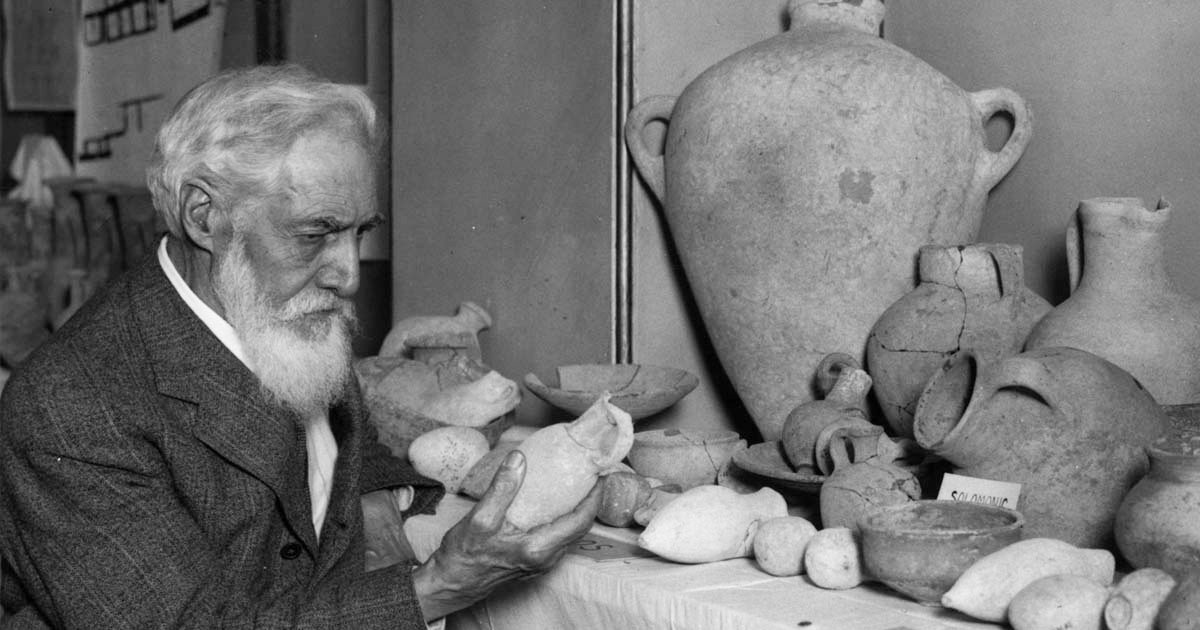
Petrie was a British Egyptologist who lived from 1853 to 1942. He is widely credited as the father of modern scientific archaeology. Before him, excavation in Egypt was largely organized treasure hunting. Wealthy sponsors sent teams to extract impressive objects, ship them to museums, and call it scholarship. The context in which an object was found, what it was buried next to, the layer of soil it came from, none of that was considered important. The object was the thing. Everything around it was, well, just dirt.
Petrie disagreed. He insisted that the context was the evidence. He set new standards by insisting on keeping a complete record of all that was found, including broken as well as whole objects. A potsherd — a fragment of broken pottery — was as important to him as a carved statue, because the potsherd told him something the statue couldn't: where in time this place had been. The object alone was just an object. In context, it was a data point that connected to every other data point around it.
From this, Petrie developed sequence dating — a way of sorting archaeological finds into chronological order by tracking how pottery styles changed over time. The idea was elegant: pottery changes, and those changes follow patterns. If you cataloged enough pottery from enough sites, you could figure out what came first and what came later, not just what was found, but when. He sorted 900 slips of paper, each representing a tomb's contents, into a sequence. It became the foundational chronology for Predynastic Egypt. A student of his, Howard Carter, a name you might know, used the same techniques prior to his discovery of Tutankhamun's tomb.
What Petrie understood, and what his predecessors missed, was that the same object means completely different things depending on where it was found. A piece of pottery recovered from a royal burial tells a different story than the identical piece found in a commoner's kitchen. The object doesn't change. The context transforms what it means.
Most brands define their audience in layers. Demographics first: age, income, gender, geography. Then psychographics: values, attitudes, interests, lifestyle. This is standard practice, and it's useful — psychographic data gets closer to the motivations behind a purchase than demographic data alone ever could. A brand that knows its customer values sustainability and outdoor adventure can speak to something real rather than just a statistical profile.
But both layers still describe the person in the abstract, who they are and what they value outside of any specific situation. What neither captures is the moment. The specific circumstances in which a product is actually encountered, considered, and reached for. Those circumstances change what the product means in ways that demographics and psychographics cannot fully predict.
You cannot understand what something is without understanding where it belongs.
Most brand communication is written for the abstracted person who exists outside any specific moment. It talks to who the customer is rather than where they are.
The brands that close this gap are the ones that ask a different question. Not just who is this person and what do they value, but: what is happening in their life right now, and what does a particular product mean in that specific moment? What are the conditions under which someone would reach for this? What job is the product doing in that context? What changes about what the product means depending on the circumstances?
Those questions lead to communication that doesn't just describe the product. It meets the customer where they actually are.
Petrie spent his career insisting that context was not the background. It was the meaning. Successful brands are the ones that insist on it too.
What does your brand communicate about the specific moment in which someone reaches for it?