Conversations
What we're saying, what's being said, what should be said.
The Jersey
What the World Cup teaches you about owned visual language.
Jonina and I were walking down the street in DUMBO on Wednesday afternoon. About a block and a half in front of us were a couple and their kid in yellow jerseys. I was already in the process of writing this essay, so I asked her, "What team?"
Without hesitation, she replied, "Brazil."
Which proves the point entirely. You don't need to see the badge or read the name. The moment that yellow appears on a pitch, a sidewalk or anywhere in the world, nearly every person — regardless of what language they speak, what country they come from or whether they follow football religiously — knows exactly who it belongs to. That is owned visual language operating at its most expressive level. A single color that has become so inseparable from a specific identity that it no longer needs any other signal to communicate it.
Dutch orange is another one worth talking about. It's not even the color of the Dutch flag. The orange comes from the House of Orange, the Dutch royal family, a connection that predates modern football by centuries and it travels across every Dutch sport simultaneously, especially F1. When the Dutch show up anywhere for anything, the orange arrives before the name does (I know a Dutch guy who only wears orange underwear). That is a brand signal so deeply embedded in a national identity that no design decision created it, and no design decision can replicate it.
The Albiceleste of Argentina and the vertical blue and white stripes that have outlasted every player who ever wore them. Messi's shirt is as recognizable as Maradona's was forty years ago. The design hasn't changed in its essential character because it doesn't need to. The stripes aren't a style choice. They are the visual expression of something specific about what Argentina believes about itself — a dignity, a seriousness, a refusal to be decorative. The jersey is an expression of the identity, not a decoration applied on top of it.
Which brings us to "the kit" of the United States.
In 2022, the US men's national team's kits were so poorly received that players held up a team photo shoot in protest. One plain white jersey. One blue tie-dye jersey. Midfielder Tyler Adams said they "didn't feel that they represented us." That sentence was the entire language problem in six words. A national team jersey that doesn't represent the players wearing it is borrowed language — visual copy that belongs to no one.
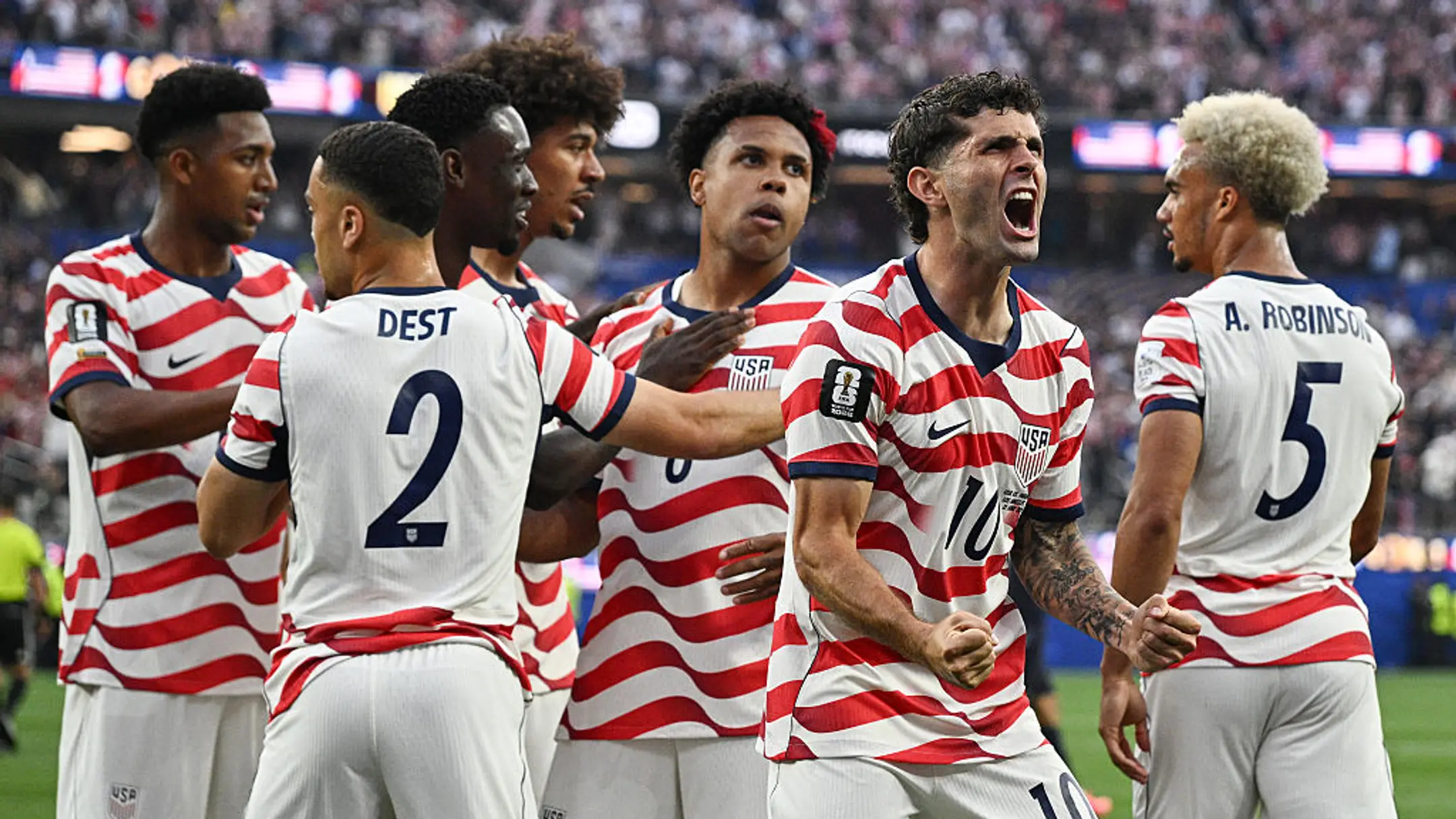
The 2026 jersey is a direct response. For the first time, the players were involved in the design process through workshops and listening sessions, giving input on everything from fabric weight to seam placement. The result is the Stripes kit — bold, wavy red and white across the front, deliberately evoking the flag and drawing on the iconic kits worn during the 1994 World Cup on home soil. For the first time, US Soccer developed a bespoke font, the Stars and Stripes typeface, created exclusively for the federation. The visual language is now unified across all 27 US Soccer national teams.
Here's what I find interesting about that. The jersey came before the tournament, obviously. The confidence it communicated came before the results. That part is not obvious at all. Visual language tells a story before a single word is spoken or before a single result is recorded. When the players said the 2022 kit didn't represent them, they were saying something precise: the visual language we're carrying into battle does not reflect who we believe we are. The 2026 jersey does.
This is the same argument I continue to make about brands. Owned visual language is not decoration. It is not the last decision you make after everything else is settled. It is a signal that travels without translation across every language, culture, and demographic on earth. Brazil's yellow works in Tokyo, Lagos, Buenos Aires and Minneapolis simultaneously because it started as a deliberate decision and became something no decision could undo.
The irony:
After the devastating 1950 World Cup final loss to Uruguay — played at home, in front of nearly 200,000 people at the Maracanã, in white — Brazil needed a new identity. The white shirt was declared a symbol of national shame. In 1953, the Brazilian Sports Confederation held a nationwide competition to design a new kit using the four colors of the national flag. The winning design was submitted by a 19-year-old newspaper illustrator named Aldyr Garcia Schlee. He was born near the Uruguayan border, and the kicker, he was a Uruguay fan! The yellow jersey that became the most recognized kit in world football was designed by someone who supported the team that caused the trauma in the first place. The new colors debuted in March 1954, and seventy-plus years of consistency did the rest.
The examples aren't limited to sport either. Apple's visual language — the white space, the materials, the restraint, the simplicity that communicates before a word is read — travels without translation across every market on earth.
Ferrari's Rosso Corsa (red) was originally a racing designation assigned to Italian cars by the FIA in the early 1900s. Ferrari inherited it, defended it, and turned a bureaucratic color assignment into one of the most owned brand signals in the world.
Tiffany trademarked Pantone 1837 — named for the year the brand was founded — because the specific shade of blue had become so inseparable from the brand that the box communicates "this is a gift" before it is opened.
UPS built an entire campaign around the question "What can Brown do for you?" because the color had become so owned that it was the ad.
Some of these were deliberate identity decisions. Others were constraints that became identity. All of them found their visual expression. The color, the form, the material — each one a product of something specific and true about what the brand actually is.
The question worth asking of every brand is the same question the US players were asking in 2022. Does this represent us? Does it say the specific thing that only we can say? Or is it borrowed language that could belong to anyone?
If you're not sure, you already have your answer.